Birmingham and the great hard Brexit feedback loop
At conference Theresa May announced that she will trigger Article 50 by the end of March 2017 and that a Great Repeal Bill will be brought forward at the next Queen’s Speech. In a piece of spin Alistair Campbell would be proud of, this Bill will actually incorporate the entire acquis communitaire into British law at the same time as shredding the European Communities Act.
While some were calling for more time before pressing the big red Article 50 button (notably one Mr George Osborne of Notting Hill) in order to wait for the result of French and German elections, there is some logic in the move. First, it means the Art 50 negotiations are completed one year ahead of the expected May 2020 general election. Second, it means the UK will not be participating in the 2019 European Parliament elections – which would have been a ludicrous charade. Third, it anchors Brexit to a firm timeline – which countries such as France are equally as keen to see as Brexit campaigners here at home.
May and her senior team faithfully kept to the line that there would be no running commentary on the negotiating position. And they kept on message at the events I attended, except for Liam Fox who we all know is itching to get out of the European Customs Union and as quickly as possible and can’t hide the fact. Nevertheless, the Government’s two red lines were the same as they were before conference – control over borders, and an end to the jurisdiction of the European Court of Justice. The UK will seek the closest trading ties possible within these parameters. While HMG’s position more or less rules out EEA membership, it leaves quite a few avenues open so long as the EU 27 are in negotiating mood.
But despite this, as the conference went on a sort of hard Brexit feedback loop started to form in which the idea that the UK was going to cut and run just seemed to take on a life its own. Why all the flapping, given that there was no new announcement except for the date of the trigger of Article 50 and a pretty prosaic bit of legal tidying up? I will hazard a guess or two:
- Team Brexit were simply more prominent at conference and they were certainly chattier in the bars and backrooms
- The change in tone from Cameron to May was so stark and uncompromising – especially on immigration – that – rightly or wrongly - it gave a sense that she couldn’t possibly favour anything other than a hard Brexit
- Chancellor Philip Hammond’s statement of the obvious that this ride is going to have some ups and downs seemed to be to some a huge revelation
- And media, EU and overseas observers were visibly taken aback by how quickly and completely the Conservative party had pivoted to the brave new world of Brexit
All this drove a sort of narrative that the Government - which remember is not offering a running commentary - didn’t really do an awful lot to assuage. After all, everyone is playing high stakes poker here. But the substance rather than the presentation is now as it was then. Nevertheless, markets put the pound under such a lot of pressure that the PM’s TV interviews last Tuesday sought to reassure the world that the UK did not want to bail completely on Europe. Ladies and Gentleman, meet Her Majesty’s Loyal Opposition – the Sterling/Dollar market:
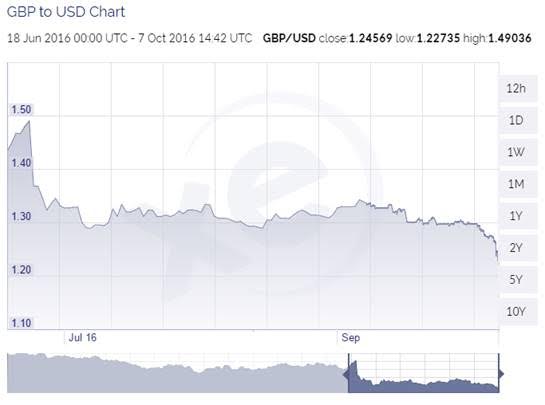
The wild drop in Sterling’s value on thin volumes overnight on Thursday hasn’t helped the jitters. In response the Chancellor on Friday told journalists at the IMF and World Bank meetings in Washington D.C. that everything was still negotiable- including continued membership of the Customs Union. But he also noted that he expected there to be more of this turbulence in the years to come. To misquote James Carville, if I am reincarnated, I want to come back as the FX market.